Discord
Where communities live.
Grow your DR (guaranteed) & Rank on Google, ChatGPT, and Claude
🚀 DR Boost — £199
5× dofollow backlinks from DR 20–70 sites
⚡ DR Mega Boost — £279 Best value
10× dofollow backlinks — 30% cheaper per link
Quick summary of Discord
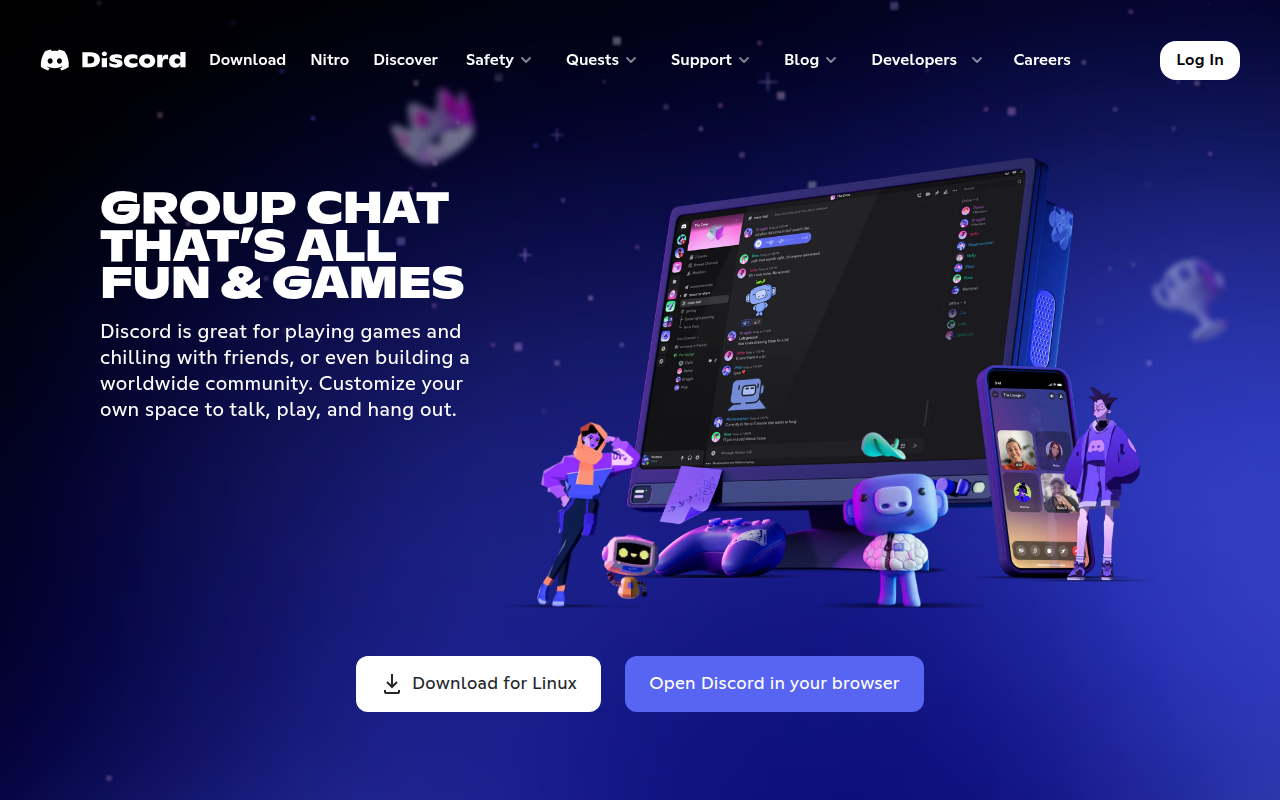
Discord is a community communication platform launched in 2015 by Jason Citron and Stanislav Vishnevskiy, originally for gamers and now used by 200M+ monthly active users for everything from open-source communities to creator audiences to indie founder masterminds. Core features: text channels with threading, voice channels, video calls, screen sharing, roles and permissions, server-specific bots and integrations, stage channels for town halls, and a mobile app. Best for product user communities, open-source project hubs, creator audiences, and any public community where real-time chat plus voice matter. Discord servers and core features are completely free with no member limits. Monetisation is via Discord Nitro ($9.99/user/month) for individual perks, plus optional Server Boosts ($4.99/boost/month) for server-wide upgrades. Direct competitors: Slack (better for internal company work, paid), Circle (creator-business focused, $89-360/mo), Mighty Networks (community + courses), Geneva (smaller, design-led), Telegram (messaging-focused), Twitch (streaming-focused chat), Reddit (forum-style). Discord wins on free, real-time, voice-friendly community; Slack wins on internal work; Circle wins on monetisation polish.
⏱ 30-second verdict
- Free, unlimited members, voice + text + video in one tool
- Massive UI familiarity — half of Gen Z grew up here
- Search and discovery break down past ~1000 members
About
Voice/video/text chat with persistent rooms. Originally for gaming, now the default for product communities, course cohorts, and DAOs.
🎯 Why it's useful
For a community around your product (not internal team comms), Discord beats Slack on retention and engagement.
💜 Our take
The voice channels work like physical rooms — you join and stay, instead of starting a meeting. Hugely better for async cohorts.
Key Features
Integrations
✓ Best for
Community builders, DAOs, course creators, and product teams who need a free, always-on hub for real-time collaboration and member engagement. Best for founders building communities around their product or audience.
✗ Not ideal for
Teams requiring formal enterprise security/compliance, privacy-first communication (Discord collects data), or those who need advanced project management—use Slack or Telegram for those needs.
How indie founders use Discord
Product user community
Free home for your SaaS users to ask questions, share tips, and feel connected to the product. Activation energy near-zero.
Open-source maintainer hub
Discord servers are the modern equivalent of IRC + forums for OSS projects. Real-time help, async threads, voice for working sessions.
Creator audience
Your subscribers + customers + biggest fans, all in one server. Roles unlock channels for paid subscribers. Voice channels for AMAs.
Indie founder mastermind
Small private servers for 10-50 founders sharing wins and frustrations. The Slack-killer for personal-network communities.
Discord is now where your community lives. Not Slack — Slack is for work. Not Facebook Groups — those died in 2018. Not Reddit — different vibe. For real-time, threaded, voice-friendly community around a product, an open-source project, or a creator's audience, Discord is the answer. For founders the value proposition is clear. Free, unlimited members, voice + video + text channels, threading, roles and permissions, custom bots, and a generation of users who already know how to use it. Setup takes 30 minutes — create a server, define a few channels (Announcements, General, Support, Off-Topic), add a couple of role tiers, you're done. Compare that to setting up a Circle or Mighty Networks community ($60-99/mo, smaller user base, less familiar UI). The killer features for community management: roles (let you grant access based on subscriber status, contributor level, etc), bots (automate moderation, polls, FAQ answers, subscription gating), threads (discussions don't pollute main channels), voice channels (drop-in casual chats), and stage channels (one-to-many town halls). The mobile app is genuinely good. Where Discord struggles: discoverability inside a server. If your community grows past 1000 members, navigating channels becomes hard. New members don't know where to start. Search across the server is limited. The 'message stream' UX works for chat but isn't great for retaining important information (which is what wikis and forums were good at). You'll end up pinning messages and creating an onboarding channel. The pricing model is unusual: Discord itself is free for everyone. The monetisation is Discord Nitro ($9.99/month per user) which gives individual users perks like higher upload limits, custom emoji, and HD streaming. There's no 'community pays for the platform' tier — Discord makes its money from individual subscribers. For founders: if your product has any community angle (open-source maintainers, creator audience, indie SaaS users), set up a Discord. The activation energy is near-zero and the network effects compound. Pair with Slack for internal company work — don't try to use Discord for both. They're different beasts.
Pricing
Discord
- ✓Unlimited servers + members
- ✓Voice + video + text channels
- ✓Roles + permissions
- ✓Bots + integrations
Nitro Basic
- ✓Custom emoji + sticker access
- ✓50MB upload limit
- ✓HD streaming
- ✓Per-user, not per-server
Nitro
- ✓500MB upload limit
- ✓4K HD streaming
- ✓2 server boosts included
- ✓Profile customization
Server Boost
- ✓Better audio quality
- ✓Higher upload limits server-wide
- ✓Custom server URL
- ✓Stacks with more boosts
Free · Nitro $9.99/mo (cosmetics & perks) · Server Boost $4.99/mo (custom features)
Frequently asked questions
Is Discord free?
Yes, completely free for all servers, channels, members, voice calls, video, and bots. Monetisation comes from Discord Nitro ($9.99/user/month) — individual perks like higher upload limits and HD streaming, paid by users not server owners.
Discord vs Slack for a startup community, which?
Slack for internal team work (better threading at scale, integrations, search). Discord for public community (free for unlimited members, voice channels, more casual). Don't try to use one for both — they have different cultures. Most startups end up with Slack internal + Discord community.
Discord vs Circle vs Mighty Networks?
Discord for free, real-time community where most members already have the app. Circle ($89-360/mo) for paid courses + community bundled, more polished UI, smaller user friction with brand new audiences. Mighty Networks for community + courses + events ecosystem. Discord wins on free + familiarity; Circle wins on creator-business polish.
Can I monetise a Discord server?
Indirectly. You can gate channels behind paid Patreon tiers, sell paid memberships via integrations (Whop, Members.io), or use roles to grant access. Discord doesn't natively process payments. The platform stays free; you handle monetisation elsewhere.
Does Discord have bots?
Yes, extensively. MEE6, Dyno, and Carl-bot handle moderation. Custom bots via Discord's API can do almost anything (auto-react to events, gate access by payment, post product updates). The bot ecosystem is one of Discord's biggest strengths for community management.
Reviews
No reviews yet — be the first.
Tools like Discord
See all Communication →Annotely
Annotate and share visual feedback on any webpage or image.
Sayfone
Cloud-based business phone system for seamless team communication.
Google Meet
Video calls inside the Google ecosystem.
Zoom
Reliable video conferencing for everyone.
Slack
The default place teams chat.