Clay
Spreadsheet that thinks — for prospecting.
Grow your DR (guaranteed) & Rank on Google, ChatGPT, and Claude
🚀 DR Boost — £199
5× dofollow backlinks from DR 20–70 sites
⚡ DR Mega Boost — £279 Best value
10× dofollow backlinks — 30% cheaper per link
Quick summary of Clay
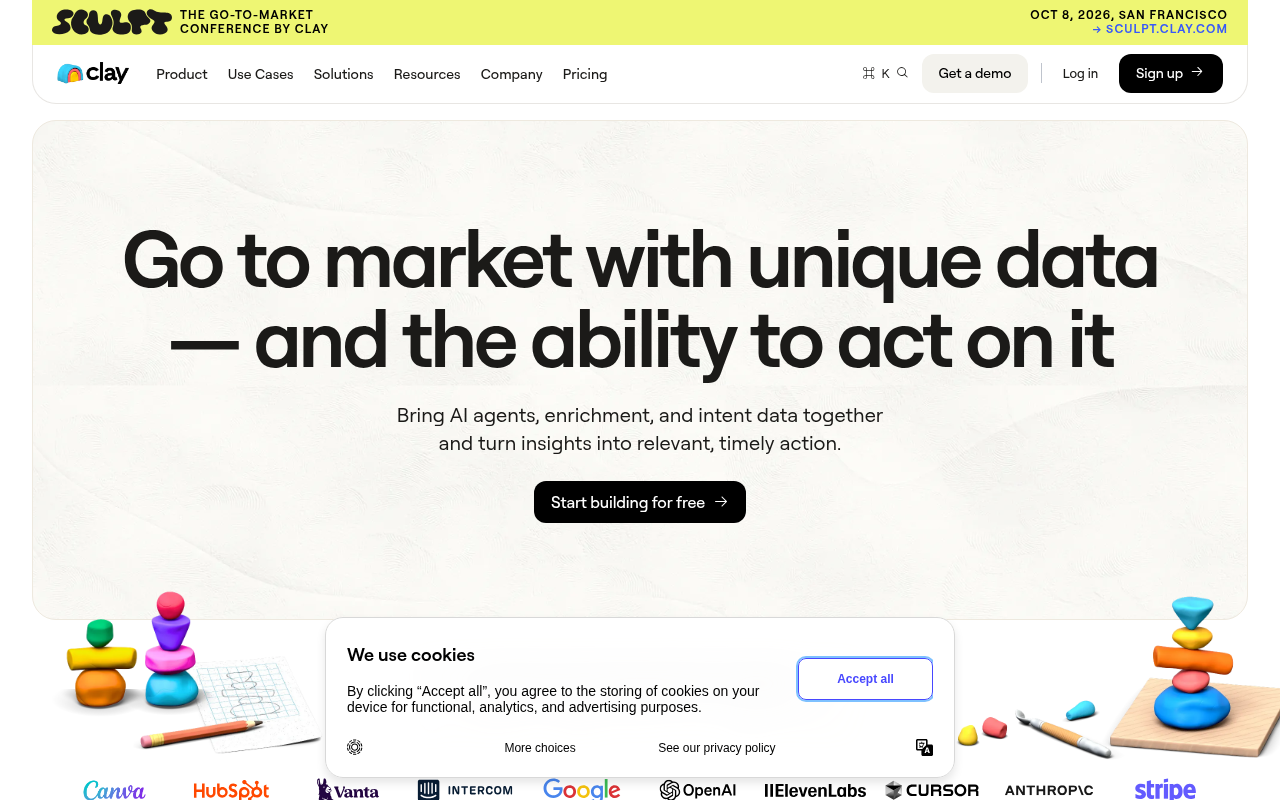
Clay is a sales intelligence and data enrichment platform founded in 2017 by Kareem Amin and Varun Anand. It pioneered the 'spreadsheet UI for B2B data enrichment' that combines 75+ data sources (LinkedIn, Crunchbase, BuiltWith, Wappalyzer, Apollo, Hunter, RocketReach, GitHub, Twitter, etc) with AI-powered personalisation. Core features: spreadsheet-style tables with chainable enrichments, AI columns powered by GPT/Claude/other LLMs, 75+ integrations across data and CRM sources, webhooks and triggers for automated workflows, and API access for programmatic use. Best for mid-stage B2B SaaS doing sophisticated outbound at scale, growth marketing teams, sales development reps, and any company doing 500+ personalised cold emails per month. Free trial with 100 credits; Starter $149/month (2K credits), Explorer $349/month (10K credits), Pro $720/month (50K credits), Enterprise custom. Direct competitors: Apollo (built-in sequencer + simpler workflow), Outreach.io (sequencer-focused), ZoomInfo (enterprise data), Lemlist (sequencer-focused with personalisation), Smartlead (similar sender focus), RocketReach (data enrichment only), Hunter (email finder). Clay wins on workflow sophistication and AI personalisation depth; Apollo wins on price + bundled sequencer; ZoomInfo wins on enterprise data.
⏱ 30-second verdict
- Chain 75+ data sources in spreadsheet UI — uniquely powerful
- AI-generated personalisation per prospect at scale
- Credit-based pricing burns fast on complex workflows
About
A grid where each cell can call an API or run an AI prompt. Enrich a list of leads with 50+ data sources and AI-personalised email drafts.
🎯 Why it's useful
Replaces 4-6 prospecting tools (data, scraping, AI, sequencer) with one. The new standard for outbound teams.
💜 Our take
The AI columns are genuinely useful — "given this person's LinkedIn, write a personalized opener" actually works.
Key Features
Integrations
✓ Best for
Sales development reps and growth teams at early-stage startups who need to enrich prospect lists and generate personalized outreach at scale. Ideal for founders building custom data pipelines without engineering resources.
✗ Not ideal for
Teams with established sales infrastructure or those seeking a simple contact database. Not ideal if you need pre-built workflows or prefer no-code simplicity over flexibility.
How indie founders use Clay
Enrich prospect lists at scale
Upload 500 company URLs, enrich each with founder, funding, tech stack, hiring signals in parallel. Multi-day task collapses to an afternoon.
AI-generated personalisation
Generate a unique opening line per prospect based on enriched signals. 'I noticed you raised Series B + posted about hiring' beats 'Hi [FIRST_NAME].'
Trigger-based outbound
Set up Clay tables that auto-enrich when new rows arrive. Webhook from your CRM → Clay enriches and personalises → Apollo sends.
Intent signal monitoring
Track companies for buying signals (LinkedIn job changes, recent funding, hiring spikes). Trigger personalised outreach when signals fire.
Clay is the most interesting B2B sales tool I've seen in years. It's a spreadsheet-meets-data-enrichment platform that turns 'I need to research 500 prospects' from a multi-day task into an afternoon. Import a list of company URLs, ask Clay to enrich each row with founder name, recent funding, tech stack, LinkedIn job changes, and any other signal you care about — then layer AI to generate personalised outreach for each row. Watching it work for the first time genuinely feels like cheating. The core innovation is the integration layer. Clay connects to 75+ data sources (LinkedIn, BuiltWith, Crunchbase, Wappalyzer, Apollo, Hunter, RocketReach, Twitter, GitHub, dozens more) and lets you chain them. Spreadsheet-style. Add a 'company URL' column, then ask Clay to add 'CEO name' from LinkedIn, 'last funding' from Crunchbase, 'tech stack' from BuiltWith, 'GitHub activity' from GitHub. Each row enriches from multiple sources in parallel. The spreadsheet UI hides genuinely sophisticated workflows underneath. For founders doing outbound the workflow is: find a target list (or import from Apollo), enrich with the signals that matter for your offer, generate personalised opening lines via AI for each row (Clay supports GPT, Claude, and other LLMs natively), export to your sequencer (Apollo, Outreach, custom). The personalisation per email is real and meaningful — not 'Hi [FIRST_NAME]' but 'I noticed you just raised Series B and your CTO posted about hiring backend engineers — we help teams like yours scale Postgres without re-platforming.' The pricing model is credits-based. Free trial covers ~100 credits to evaluate. Starter at $149/month for 2K credits. Explorer at $349/month for 10K credits. Pro at $720/month for 50K credits. Credits scale per enrichment per row — a sophisticated workflow can burn through credits faster than expected. Compared to Apollo's per-user pricing, Clay rewards volume but punishes light use. Clay's growth is real. They went from ~$1M ARR to ~$50M ARR in about 2 years, mostly via word-of-mouth among growth and sales teams. The product has become required tooling for serious B2B outbound at growth-stage SaaS. My take: if you're doing B2B outbound and you need personalisation at scale, Clay is the new default. The free trial is enough to validate. Pay for Starter or Explorer based on volume. Pair with Apollo (cheaper data + sequencer) or Outreach.io (enterprise sequencer) — Clay's role is the enrichment + personalisation layer, not the sender. For indie founders sending under 100 cold emails per week, Apollo alone is probably enough. For scaled outbound, Clay is the unlock.
Pricing
Free
- ✓100 credits to evaluate
- ✓All core features
- ✓Basic AI usage
- ✓No credit card needed
Starter
- ✓2,000 credits/month
- ✓Up to 25K rows per table
- ✓API access
- ✓Email + chat support
Explorer
- ✓10,000 credits/month
- ✓Unlimited table size
- ✓Webhooks + triggers
- ✓Priority support
Pro
- ✓50,000 credits/month
- ✓Phone support
- ✓Custom integrations
- ✓Power-user workflows
Enterprise
- ✓Unlimited credits
- ✓SSO + audit log
- ✓Dedicated CSM
- ✓Custom contracts
Free tier available · Pro from $50/mo · Team plans available · Pay-as-you-go credits for API calls
Frequently asked questions
Is Clay free?
There's a free trial with 100 credits to evaluate. After that pricing starts at $149/month for Starter (2K credits). Most serious users land on Explorer ($349/mo, 10K credits) or Pro ($720/mo, 50K credits).
Clay vs Apollo, which should I use?
Apollo for cheap B2B data + built-in sequencer at $59-99/user/month. Clay for sophisticated enrichment workflows that combine 75+ data sources with AI-powered personalisation. Most sophisticated B2B teams use both: Apollo for base data + sequencing, Clay for enrichment + personalisation.
What is a 'credit' in Clay?
Each enrichment per row counts as credits. Different sources cost different amounts (LinkedIn enrichment ~1 credit, GPT-4 personalisation ~2-3 credits, deeper enrichment from premium sources may cost 5-10 credits). A row enriched from 5 sources with AI personalisation might cost 10-15 credits total.
Can Clay replace my sequencer?
No. Clay handles enrichment and personalisation. You still need a sequencer (Apollo, Outreach.io, Lemlist, Smartlead) to actually send emails. The typical workflow: build + enrich list in Clay → export to your sequencer → send. Clay also integrates with sequencers via API for automated handoff.
What kind of teams use Clay?
Mostly mid-stage B2B SaaS doing sophisticated outbound — Series A through Series D. Growth-stage marketing teams. Sales development reps targeting enterprise. Less useful for solo founders sending under 100 cold emails per week (Apollo alone is simpler). The breakeven is roughly 500+ targeted emails per month with real personalisation.
Reviews
No reviews yet — be the first.
Tools like Clay
See all Sales →Tome
AI-powered presentations and sales decks that create themselves.
Laxis
AI meeting assistant that automates note-taking and CRM updates.
Amplemarket
AI-powered sales platform that automates your entire outbound process.
Reply
AI-powered sales engagement platform to automate multichannel outreach.
Close
CRM with built-in calling, email, and SMS.
Hunter.io
Find verified email addresses in seconds.