Mailchimp
The email-first marketing platform.
Grow your DR (guaranteed) & Rank on Google, ChatGPT, and Claude
🚀 DR Boost — £199
5× dofollow backlinks from DR 20–70 sites
⚡ DR Mega Boost — £279 Best value
10× dofollow backlinks — 30% cheaper per link
Quick summary of Mailchimp
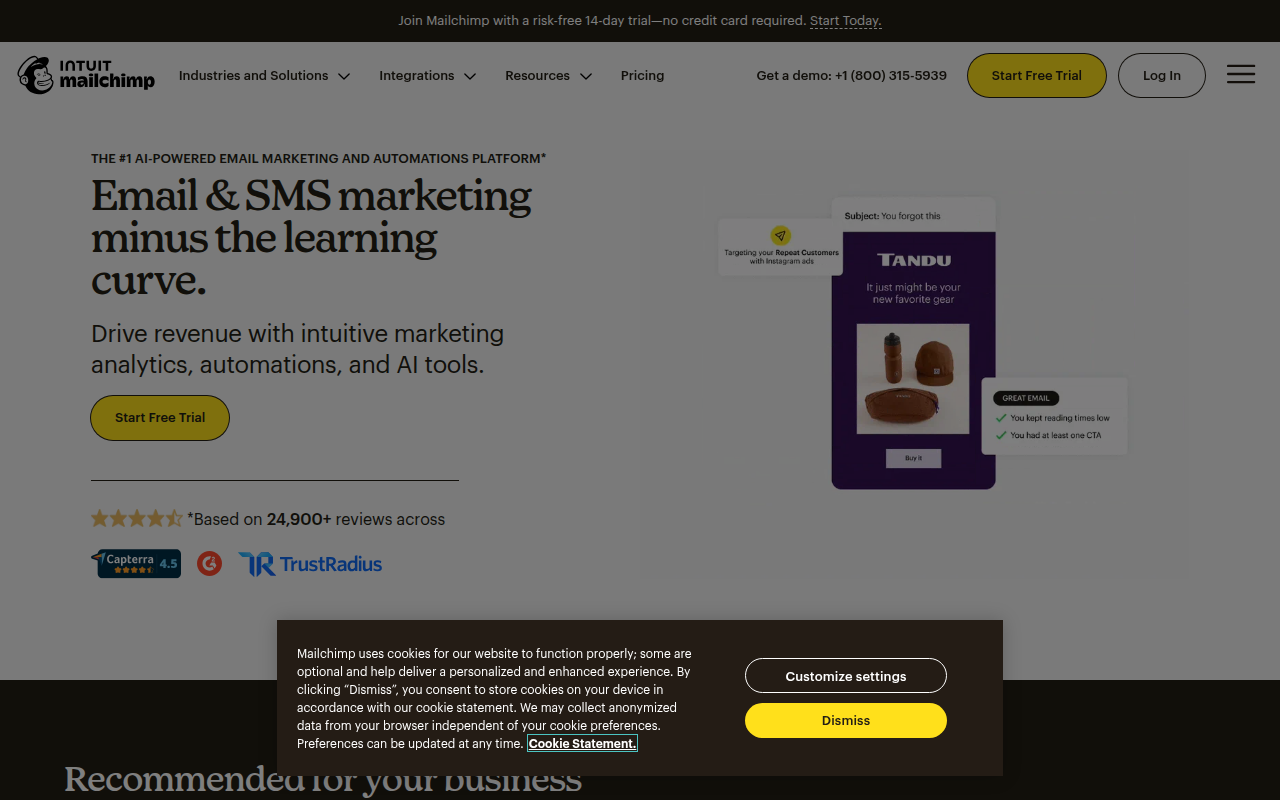
Mailchimp is one of the original email marketing platforms, founded in 2001 by Ben Chestnut and Dan Kurzius and acquired by Intuit in 2021 for $12B. It's a comprehensive email marketing and marketing automation suite covering newsletters, drip campaigns, audience management, landing pages, signup forms, and integrations with 300+ apps (Salesforce, Shopify, WooCommerce, etc). Best for non-technical marketing teams at small businesses, e-commerce stores, and legacy customers who value the brand and integration depth. The free tier is capped at 500 contacts and 1000 monthly sends. Paid plans start at $13/month (Essentials, 500 contacts) and scale to $350+ for 10K+ contacts. Direct competitors: beehiiv (newsletter-focused, no revenue cut), Kit / ConvertKit (creator business focused), Resend (developer-focused transactional), Brevo (cheaper Mailchimp alternative), MailerLite (similar feature set, less expensive), Klaviyo (e-commerce-focused, deeper), Customer.io (lifecycle marketing, B2B). Mailchimp wins on brand recognition and integration ecosystem; modern competitors win on price and target-audience-specific workflows.
⏱ 30-second verdict
- Legacy default, biggest integration ecosystem, every marketer knows it
- Drag-and-drop email design is genuinely friendly for non-devs
- Pricing scales fast, modern competitors are cheaper at every tier
About
Email campaigns, automations, landing pages, and basic CRM. Long history; broad integrations. Free up to 500 contacts.
🎯 Why it's useful
Probably the most universally-supported email platform. Every tool has a Mailchimp integration.
💜 Our take
The Behavioral Targeting feature is more sophisticated than newer competitors give it credit for.
Key Features
Integrations
✓ Best for
Solo founders and small marketing teams launching their first email marketing campaigns. Best for e-commerce and SaaS startups under 500 contacts who need an all-in-one platform without upfront costs.
✗ Not ideal for
Teams needing advanced CRM functionality or sophisticated workflows should look elsewhere—Mailchimp's CRM is basic. Also not ideal for high-volume senders or teams requiring dedicated support.
How indie founders use Mailchimp
General marketing emails
Promotional emails, product updates, e-commerce campaigns. The 'safe default' for marketing teams who want a familiar tool.
E-commerce email automation
Cart abandonment, post-purchase sequences, product recommendations. Deep Shopify and WooCommerce integrations.
Audience segmentation
Tag and segment contacts by behaviour, demographics, purchase history. More mature than newer competitors for complex segmentation.
Landing pages + signup forms
Mailchimp's bundled landing-page builder is decent for simple lead capture. Less powerful than dedicated tools but free with the platform.
Honest answer: in 2026, you probably shouldn't be on Mailchimp unless you've already been on it for years. The product is fine. The brand is legendary. But the pricing has gotten aggressive, the UI feels like 2014, and the competition (Resend for devs, Beehiiv for newsletters, Kit for creators, even Substack for solos) has lapped them in every direction. What Mailchimp still does well: it's the safe corporate default. If you're at a non-technical company where the marketing team doesn't want to learn a new tool, Mailchimp works. They have every integration (Salesforce, HubSpot, Shopify, WooCommerce, etc), a giant template library, drag-and-drop email design that non-developers find approachable, automation workflows, and audience segmentation that's deeper than newer competitors. Where Mailchimp loses badly: pricing. The free tier is now capped at 500 contacts (down from 2000). Essentials starts at $13/mo for 500 contacts and scales linearly with audience size — at 50K contacts you're looking at $400/mo+, which is significantly more than Beehiiv or Kit at the same volume. Standard ($20-100+/mo depending on contacts) adds the automation features. The 'pay more for the same product as you grow' model feels punitive after years on better-priced competitors. The Intuit acquisition (2021) hasn't helped. Mailchimp got integrated into QuickBooks for small-business marketing-meets-accounting, which makes sense for someone running a coffee shop. For tech startups, the synergy is invisible and the product direction is unclear. My actual advice for founders: if you're not already on Mailchimp, don't start. For transactional email use Resend. For newsletters use Beehiiv. For creator businesses use Kit. For full marketing automation use Customer.io or Brevo. Mailchimp's best era was 2010-2018; the market has moved on. If you're already on Mailchimp and it works for your team, fine — staying isn't dangerous, just expensive. Migration is real work (segments, automation rebuilds, deliverability rewarming). Plan for it when contract renewal makes you wince at the bill.
Pricing
Free
- ✓Up to 500 contacts
- ✓1000 monthly email sends
- ✓Basic templates
- ✓Limited automation
Essentials
- ✓10x email sends
- ✓All templates
- ✓Custom branding
- ✓A/B testing
- ✓Email support
Standard
- ✓12x email sends
- ✓Customer journey builder
- ✓Advanced segments
- ✓Predictive segments
- ✓AI-powered features
Premium
- ✓For 10K+ contacts
- ✓Unlimited sends
- ✓Multivariate testing
- ✓Phone support
- ✓Custom-branded reports
Free up to 500 contacts · Standard $20/mo · Premium $350/mo · Enterprise custom pricing
Frequently asked questions
Is Mailchimp free?
There's a free tier capped at 500 contacts and 1000 monthly sends, with watermarked emails. Most growing businesses outgrow it within months. Paid tiers start at $13/month for 500 contacts and scale linearly.
Mailchimp vs beehiiv, which should I pick?
beehiiv for newsletters as a business — better growth tools, no revenue cut, cleaner UI. Mailchimp for non-newsletter marketing automation, e-commerce integrations, and the deepest template library. For most modern startups in 2026, beehiiv is the better default.
Mailchimp vs Kit (ConvertKit), what's the difference?
Kit for creator businesses (newsletters + courses + digital products + memberships under one roof). Mailchimp for general marketing automation across email, audience, e-commerce. Kit wins on creator workflows; Mailchimp wins on traditional marketing teams.
Should I migrate off Mailchimp?
Migrate if you're paying $200+/month and a competitor offers equivalent features for cheaper. Stay if your team is non-technical and the workflows are working. Migration is real work — segments, automations, deliverability rewarming all take time. Don't migrate just because Mailchimp is unfashionable.
What happened to Mailchimp's free tier?
Mailchimp cut the free tier from 2000 to 500 contacts in 2022 and increased pricing across the board after the Intuit acquisition. Many indie founders and small businesses migrated to MailerLite, Brevo, or beehiiv in response.
Reviews
No reviews yet — be the first.
Tools like Mailchimp
See all Marketing →Beehiiv
The newsletter platform creators are switching to.
Qura
AI-powered social media replies that turn comments into customers.
Postel
Schedule and automate your social media posts with AI assistance.
SocialRails
Schedule and automate your social media posts with ease.
Post bridge
Cross-post your content to multiple social media platforms instantly.
Dead Link Checker
Find and fix broken links on your website automatically.