Hugging Face
GitHub for machine-learning models and datasets.
Grow your DR (guaranteed) & Rank on Google, ChatGPT, and Claude
🚀 DR Boost — £199
5× dofollow backlinks from DR 20–70 sites
⚡ DR Mega Boost — £279 Best value
10× dofollow backlinks — 30% cheaper per link
Quick summary of Hugging Face
Hugging Face is the central platform of the open-source AI ecosystem, founded in 2016 by Clément Delangue, Julien Chaumond, and Thomas Wolf in Paris (now NYC headquartered). Originally a chatbot startup that pivoted in 2018 to building the Transformers Python library — the library that became the standard interface for using BERT, GPT-style, and modern LLM/diffusion models in research and production. Now hosts 1M+ models, 100K+ datasets, 200K+ public Spaces demos, and serves millions of developers and researchers. Often called 'the GitHub for machine learning'. Core features: Model Hub with 1M+ models across NLP/computer vision/audio/multimodal modalities (download, use, fine-tune), Dataset Hub with 100K+ public datasets for training and evaluation, Spaces with 200K+ free demo apps built using Gradio/Streamlit running any model in browser, Inference API for hosted inference of any Hub model (free tier with rate limits, paid Inference Endpoints for production), AutoTrain for fine-tuning models via UI without code, Transformers library as de facto Python standard for transformer models (10M+ pip installs/month), Diffusers library for diffusion models (Stable Diffusion, Flux), PEFT for parameter-efficient fine-tuning (LoRA, adapters), Accelerate for distributed training, TGI (Text Generation Inference) production-grade LLM serving stack, Optimum for hardware-optimised inference (Nvidia, Intel, AWS Inferentia), Enterprise Hub for private model hosting with compliance, active community discussions where new models and papers get released and discussed in real-time. Best for finding pre-trained models for any task via search across 1M+ models, using models via free Inference API for evaluation in 5 minutes, building AI demos via Spaces in Gradio/Streamlit hosted free, fine-tuning models for domain-specific use cases via AutoTrain or notebooks, staying current on AI research with daily new model releases and community discussions, self-hosting open-source LLMs via TGI for serving LLaMA/Qwen/Mistral on own infrastructure, comparing model benchmarks via Hugging Face's leaderboards, building production AI pipelines with industry-standard Transformers and Diffusers libraries. Pricing: Free tier (public models, Spaces hosting, Inference API rate-limited, all libraries), Pro at $9/month (unlimited private models, higher API limits, Pro badge), Inference Endpoints pay-per-use ($0.06-$30+/GPU-hour by hardware class), Enterprise Hub at $20+/user/month (SSO, private hosting, compliance). Direct competitors: Replicate (single-API model hosting, more polished but fewer models), Together AI (LLM-focused production inference, cheaper at scale), Fireworks AI (fast LLM inference specialist), Modal (custom serverless compute), RunPod (raw GPU rental cheapest), Banana (deprecated), Beam, AWS Bedrock (enterprise proprietary models), Anyscale (Ray-focused), Anthropic/OpenAI (proprietary frontier APIs). Hugging Face wins on ecosystem completeness and community network effects and library standardisation; Replicate wins on production-ready single-API simplicity; Together/Fireworks win on LLM inference cost at scale; Modal wins on custom serverless compute; RunPod wins on raw GPU cost.
⏱ 30-second verdict
- Central platform of open-source AI — model hub + datasets + libraries + Spaces + community
- Transformers library is industry standard (10M+ downloads/month); Free tier genuinely useful
- Inference API rate-limited; for production LLM inference, Together/Fireworks have edge
About
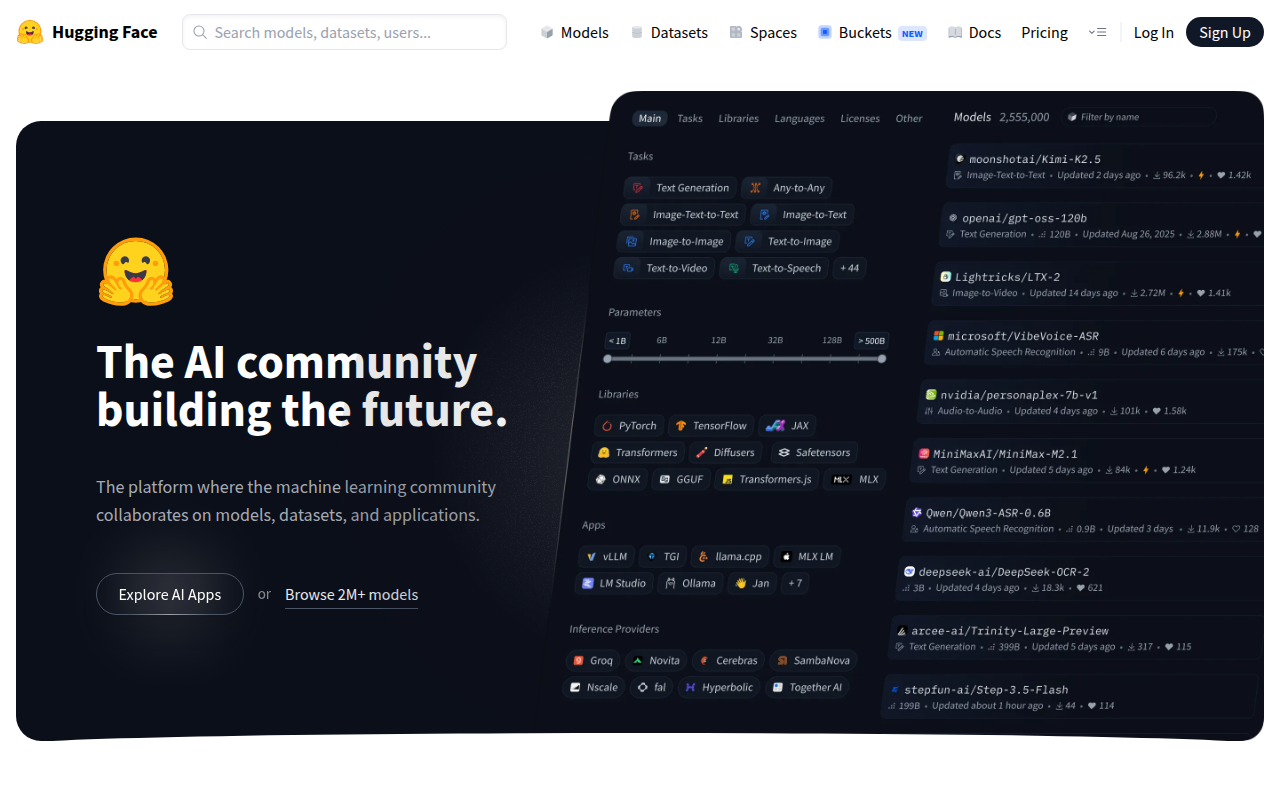
Hosts >1M open-source models, datasets, and Spaces. Inference API serves any of them; Spaces lets you deploy a Gradio/Streamlit demo for free.
🎯 Why it's useful
The fastest way to ship an ML demo to investors or early users. No GPU bill, no devops.
💜 Our take
The leaderboards make benchmark comparisons honest. You can see what's actually state-of-the-art today, not last quarter.
Key Features
Integrations
✓ Best for
ML engineers and indie founders building AI features fast without infrastructure costs. Solo developers and small teams leveraging pre-built models to ship NLP, vision, or audio products quickly.
✗ Not ideal for
Teams needing dedicated support or SLAs; those requiring proprietary/closed-source models; companies with strict data residency requirements (free tier trains on shared infrastructure).
How indie founders use Hugging Face
Find pre-trained models
Search 1M+ open-source models by task (NER, sentiment, image classification, etc.). Free to use via Inference API.
Build AI demos in Spaces
Prototype ML apps in Gradio/Streamlit hosted free. 200K+ existing demos to learn from. Cheapest AI prototyping infrastructure.
Fine-tune models for your domain
AutoTrain for code-free fine-tuning, or Jupyter notebooks for custom workflows. Save thousands vs OpenAI fine-tuning API.
Track AI research in real-time
Daily new models + papers + community discussions. The platform where open-source AI research happens.
Hugging Face is the GitHub for machine learning — the platform where the open-source AI ecosystem lives, founded in 2016 by Clément Delangue, Julien Chaumond, and Thomas Wolf in Paris (now NYC-based). Originally launched as a chatbot startup, Hugging Face pivoted in 2018 to building the Transformers Python library (the library that became the standard interface for using BERT, GPT-style models in research and production). That pivot transformed Hugging Face into the central platform of the open-source AI movement — 1M+ models hosted, 100K+ datasets, 200K+ public Spaces (demo apps), and a community of millions of developers, researchers, and AI enthusiasts. What makes Hugging Face unique is the combination of platform + community + tooling. Other AI infrastructure plays focus on one thing — Replicate is model hosting, Modal is custom compute, Together is LLM inference. Hugging Face is everything at once: model hub, dataset hub, demo apps (Spaces), training infrastructure (AutoTrain), inference endpoints, evaluation benchmarks, libraries (Transformers, Diffusers, PEFT, Accelerate), and the community discussions where new models get released and discussed in real-time. For anyone doing serious open-source AI work, Hugging Face is unavoidable. The core features: • **Model Hub** — 1M+ models across NLP, computer vision, audio, multimodal. Download, use, fine-tune. • **Dataset Hub** — 100K+ public datasets for training and evaluation • **Spaces** — 200K+ free demo apps built by community using Gradio + Streamlit. Run any model in browser. • **Inference API + Endpoints** — hosted inference of any Hub model, free tier + paid dedicated endpoints • **AutoTrain** — fine-tune models without code via simple UI • **Transformers library** — the de facto Python library for using transformer models (10M+ pip installs/month) • **Diffusers library** — equivalent for diffusion models (Stable Diffusion, Flux, etc.) • **PEFT (Parameter-Efficient Fine-Tuning)** — LoRA + adapter-based fine-tuning library • **Accelerate library** — distributed training abstractions • **TGI (Text Generation Inference)** — production-grade LLM serving stack • **Optimum** — hardware-optimised inference (Nvidia, Intel, AWS Inferentia) • **Enterprise Hub** — private model hosting for organizations with compliance requirements • **Discussions + community** — model and dataset discussions, ML research conversations For founders + ML engineers + researchers the use cases: • **Find pre-trained models for your use case** — search 1M+ models by task (NER, sentiment, image classification, etc.) • **Use models via free inference API** — try any model in 5 minutes via the Inference API • **Build AI demos via Spaces** — prototype ML apps in Gradio/Streamlit hosted free • **Fine-tune models for your domain** — AutoTrain or notebooks for custom training • **Stay current on AI research** — daily new models + papers + discussions in the community • **Self-host open-source LLMs** — use TGI to serve LLaMA/Qwen/Mistral on your infrastructure • **Compare model benchmarks** — Hugging Face's Open LLM Leaderboard + other evaluations • **Build production AI pipelines** — Transformers + Diffusers libraries are the industry standard The pricing is freemium with enterprise scaling. Free tier is generous — public models + Spaces hosting + Inference API with rate limits, all free. Pro at $9/month gets unlimited private models + datasets + higher Inference API limits. Inference Endpoints for production deployments are pay-per-use (compute time + GPU class — varies $0.06/hour to $30+/hour depending on hardware). Enterprise Hub starts at $20/user/month for organisations with SSO + private hosting + compliance features. Where Hugging Face wins clearly: it's the central platform of the open-source AI ecosystem — model releases, dataset releases, library releases all happen here; the breadth (model hub + datasets + libraries + Spaces + inference) is unmatched; the Transformers library is the industry standard with 10M+ downloads/month; the community + discussions create real network effects (new models get discussed immediately); the free tier is genuinely useful for evaluation and prototyping. Where it loses: Inference API has rate limits + slower cold starts than dedicated platforms like Together AI or Fireworks for production LLM inference; for production deployment of specific models, Replicate or Modal have more polished workflows; Inference Endpoints pricing can be expensive at scale vs renting raw GPUs (RunPod, Lambda); the UI is increasingly complex as the platform has grown. My take: for anyone doing serious open-source AI work — researchers, ML engineers, data scientists, indie AI builders — Hugging Face is unavoidable infrastructure. The Transformers + Diffusers libraries are how you actually use open-source models in code. The Hub is where you discover models. Spaces is where you build quick demos. For pure production LLM inference, alternative platforms (Together, Fireworks, Replicate) may be better per dollar. But for the entire R&D lifecycle of open-source AI work, Hugging Face is the platform that makes everything else possible.
Pricing
Free
- ✓Public models + Spaces hosting
- ✓Inference API (rate limited)
- ✓Transformers + Diffusers libraries
- ✓Community access
Pro
- ✓Unlimited private models + datasets
- ✓Higher Inference API limits
- ✓Pro badge in community
- ✓Priority support
Inference Endpoints
- ✓Production deployment
- ✓$0.06-$30+/hour by hardware
- ✓Auto-scaling
- ✓Dedicated GPU
Enterprise Hub
- ✓SSO + SAML
- ✓Private hosting
- ✓Compliance + audit logs
- ✓Dedicated support
Free · Inference API pay-as-you-go · Pro $9/mo · Spaces (free & paid tiers) · Enterprise custom
Frequently asked questions
Hugging Face vs Replicate?
Hugging Face hosts more models (1M+ vs Replicate's 100K) but the inference experience varies by model. Replicate has fewer but more polished deployments with consistent single-API pattern. For exploring research + free model use + building demos, Hugging Face. For production-ready single-API inference, Replicate.
What is Hugging Face used for?
Three main use cases: (1) discovering and using open-source AI models (model hub), (2) building ML applications with industry-standard libraries (Transformers, Diffusers), (3) building demo apps and prototypes (Spaces). Plus community discussions where new AI research is shared and discussed in real-time.
Is Hugging Face free?
Yes — free tier covers public models, Spaces hosting, Inference API (with rate limits), all libraries. Pro at $9/month unlocks unlimited private models + higher API limits. Inference Endpoints for production are pay-per-GPU-hour. Enterprise Hub starts at $20/user/month for organisations.
Can I run Stable Diffusion / LLaMA on Hugging Face?
Yes — both are on the Hugging Face Hub. Via free Inference API for evaluation (rate-limited), Spaces for demo apps, or Inference Endpoints for production deployment. Many LLaMA + Mistral + Qwen variants available. Self-host via Transformers + TGI on your own GPU.
What is a Hugging Face Space?
Spaces are free hosted demo apps where developers showcase ML models via Gradio or Streamlit interfaces. 200K+ public Spaces — try any model in browser without writing code. Common pattern: researcher releases new model → demo Space lets you try it in 30 seconds. Many startup founders prototype AI features on Spaces before building production.
Reviews
No reviews yet — be the first.
Tools like Hugging Face
See all AI & ML →ChatGPT
The AI assistant that started it all.
Claude
Anthropic's thoughtful, longer-context AI.
Cursor
The AI-native code editor that ships.
Stylar
Stylar is an AI-powered design partner that revolutionizes image generation by offering precise control over composition and style. With its advanced features, users can effortlessly achieve their desired designs. Stylar provides a seamless user experience for professionals in various fields.
RenderNet AI
RenderNet is an AI image generator that allows you to create consistent, high-quality characters with complete control over pose, composition, and style.
Recraft.ai
The first generative AI design tool that lets users create and edit digital illustrations, art, and 3D graphics in a uniform brand style.